En la industria textil, los tejidos ignífugos se utilizan cada vez más en una amplia gama de aplicaciones, desde ropa de trabajo de protección industrial y tejidos decorativos para espacios públicos hasta ropa infantil y tapicería de vehículos. Sus propiedades ignífugas tienen un impacto directo en la seguridad personal y ambiental. Este artículo describe los métodos de ensayo, las normas básicas y las consideraciones clave durante el proceso de ensayo de los tejidos ignífugos, sirviendo como referencia para los profesionales del sector.
I. Métodos de ensayo para textiles ignífugos
La clave para evaluar los textiles ignífugos reside en analizar su comportamiento ante la combustión al exponerse a una fuente de fuego, incluyendo indicadores clave como la velocidad de propagación de la llama, el tiempo posterior a la combustión, el tiempo de combustión lenta, el grado de daño y la emisión de humo. Actualmente, los métodos de ensayo más comunes se dividen principalmente en cinco categorías, cada una adaptada a diferentes escenarios de aplicación con principios y enfoques de ensayo específicos.
(1) Prueba de combustión vertical
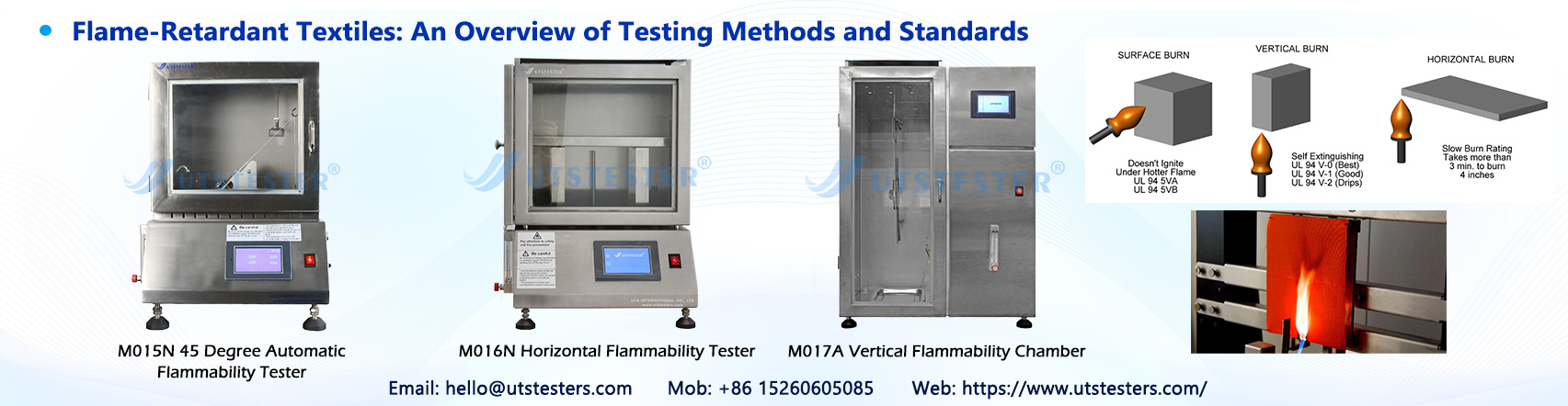
La prueba de combustión vertical es el método de ensayo de resistencia al fuego más común y fundamental, adecuado para la mayoría de los tejidos de prendas de vestir, ropa de protección, ropa de cama y productos similares. Su principio básico consiste en simular las características de combustión de un tejido suspendido verticalmente. El ensayo implica sujetar la muestra verticalmente y aplicar una fuente de ignición estándar (normalmente un mechero Bunsen con una llama de 40 mm de altura) en el borde inferior de la muestra durante un tiempo determinado (generalmente 12 segundos) antes de retirar la llama. A continuación, se registra el tiempo posterior a la combustión, el tiempo de combustión latente y la longitud del daño tras la combustión para evaluar el rendimiento ignífugo del tejido.
Las ventajas de este método incluyen su simplicidad y amplia aplicabilidad. Proporciona una representación intuitiva del comportamiento ignífugo del tejido en condiciones reales de uso o colgado, lo que lo convierte en el método preferido para las inspecciones de salida de fábrica y las pruebas de laboratorio rutinarias. Entre las normas pertinentes se incluyen GB/T 5455-2014, ISO 15025 y ASTM D6413, entre otras; las especificaciones relativas a la altura de la llama, la duración de la ignición y los criterios de aprobación varían ligeramente según las distintas normas.
(2) Prueba de combustión horizontal
La prueba de combustión horizontal es especialmente adecuada para textiles ligeros, telas decorativas (como cortinas y manteles) y telas recubiertas de plástico, ya que simula la combustión cuando la tela se coloca horizontalmente. El principio de la prueba consiste en colocar la muestra horizontalmente sobre un soporte específico, encenderla desde un extremo con una fuente de llama, observar la propagación de la llama y medir la velocidad de propagación y la longitud del daño. Algunas normas también exigen registrar si se producen gotas fundidas durante la combustión.
En comparación con el método de combustión vertical, el método de combustión horizontal pone mayor énfasis en evaluar la capacidad de propagación de la llama de un tejido cuando está extendido, lo que lo hace especialmente adecuado para textiles que suelen colocarse horizontalmente durante su uso diario. Las normas comunes incluyen GB/T 2408-2021, ASTM D635 e ISO 6941. De estas, la GB/T 2408-2021 contempla tanto la combustión vertical como la horizontal, cumpliendo así con los requisitos de ensayo para una amplia gama de tejidos.
(3) Método de combustión a 45 grados
El método de combustión a 45 grados está diseñado principalmente para textiles colgantes, como cortinas, visillos y telones de escenario. Simula las características de combustión de estos tejidos cuando se cuelgan en ángulo. El principio de la prueba consiste en fijar la muestra a un ángulo de 45 grados con respecto al plano horizontal, encenderla desde la parte inferior, medir el tiempo de combustión y la extensión del daño, y evaluar la velocidad de propagación de la llama a lo largo de la superficie inclinada del tejido.
Este método reproduce fielmente los escenarios de uso reales de los textiles colgantes, reflejando con precisión los patrones de difusión de las llamas en superficies inclinadas y evitando discrepancias en los resultados causadas por ángulos de prueba inadecuados. Entre las normas más comunes se encuentran la NFPA 701 de EE. UU. (dividida en la estricta Clase 1 y la general Clase 2) y la GB/T 5456-2015 de China. De estas, la NFPA 701 es la norma de referencia principal para las pruebas de resistencia al fuego de textiles colgantes a nivel mundial y se utiliza ampliamente en la inspección de productos de exportación.
(4) Método del Índice de Oxígeno Limitante (LOI)
El método del Índice de Oxígeno Límite (LOI) es un método de ensayo cuantitativo adecuado para la evaluación precisa del rendimiento ignífugo de los textiles, especialmente para el control de calidad durante la fase de I+D y para productos de alta gama. El principio del ensayo consiste en colocar la muestra en una atmósfera de nitrógeno y oxígeno y ajustar gradualmente la concentración de oxígeno hasta determinar la concentración mínima necesaria para que la muestra mantenga la combustión (es decir, el Índice de Oxígeno Límite, LOI). Un valor más alto indica un mayor rendimiento ignífugo del tejido.
En general, un LOI ≥ 28 % se clasifica como tejido ignífugo, mientras que un LOI ≤ 20 % indica un tejido inflamable. La ventaja de este método radica en sus resultados de prueba precisos y cuantificables, que proporcionan datos científicos para el desarrollo de productos y la formulación de estándares. Entre las normas relevantes se incluyen la ISO 4589-2 internacional, la GB/T 5454-1997 de China y la ASTM D2863 de EE. UU., entre otras. Este método constituye una herramienta de prueba fundamental para que las empresas textiles mejoren la calidad de sus productos.
(5) Pruebas complementarias para aplicaciones especiales
Además de los cuatro métodos básicos descritos anteriormente, los textiles ignífugos destinados a aplicaciones especiales deben someterse a pruebas específicas:
1. Prueba de densidad de humo: Simula la emisión de humo de telas en combustión en espacios cerrados (como el metro y los aviones). La densidad de humo (valor Ds) se mide utilizando el método de atenuación de la luz para prevenir la asfixia causada por el humo durante un incendio. Las normas comunes incluyen GB/T 8627-2007 e ISO 5659-2;
2. Prueba de radiación térmica: Diseñada para prendas y tejidos de protección industrial utilizados en entornos de alta temperatura, esta prueba simula escenarios de radiación de alta temperatura para evaluar el rendimiento de protección térmica del tejido (valor TPP). Las normas pertinentes incluyen GB 8965.1-2023 e ISO 13506;
3. Prueba de solidez al lavado: Evalúa la durabilidad de las propiedades ignífugas de los tejidos tras lavados repetidos. Normalmente, los tejidos se procesan según los procedimientos de lavado especificados en GB/T 8629-2017, seguidos de pruebas básicas de resistencia al fuego para garantizar que el tejido siga cumpliendo las normas incluso después de un uso prolongado;
4. Prueba de toxicidad por humo: Para tejidos interiores utilizados en edificios y vehículos, esta prueba mide la liberación de gases tóxicos durante la combustión para prevenir daños secundarios. Las normas más comunes son GB/T 20284-2006 y BS 6853.
II. Normas para textiles ignífugos
(1) Serie GB
La norma GB/T 17591-2025, que entró en vigor en 2025, es la norma básica más reciente. Sustituye a la edición de 2006 y perfecciona aún más los criterios de ensayo y los requisitos de clasificación.
1. GB/T 17591-2025 “Tejidos ignífugos”: Norma recomendada fundamental que abarca tejidos ignífugos para prendas de vestir, decoración y uso industrial. Introduce ocho términos nuevos, entre ellos longitud de combustión, densidad de humo y valores de rendimiento de protección térmica. Ajusta los elementos de ensayo y los requisitos de rendimiento para diferentes aplicaciones, como decoración de interiores, interiores de vehículos y ropa de protección ignífuga, incluyendo la adición de requisitos de Clase B3 para tejidos de decoración de interiores y la clasificación de la densidad de humo para tejidos de interiores de automóviles.
2. GB/T 5455-2014 “Textiles—Resistencia a la llama—Determinación de la longitud de combustión vertical, el tiempo de combustión latente y el tiempo de incandescencia”: Una norma recomendada que corresponde al método de combustión vertical, aplicable a las pruebas rutinarias de resistencia a la llama de diversos textiles. Especifica la preparación de la muestra, los procedimientos de prueba y los criterios de aceptación, y es una norma de uso común para las pruebas de salida de fábrica;
3. GB 8965.1-2023 “Ropa de protección—Protección ignífuga—Parte 1: Ropa ignífuga”: Norma obligatoria para ropa de protección ignífuga industrial. Especifica elementos de ensayo como la combustión vertical y la radiación térmica, introduce nuevos requisitos de clase B2 y B3, y ajusta parámetros como la duración de la combustión y el tiempo posterior a la llama. Se aplica a la ropa de trabajo de protección utilizada en entornos de llama abierta y alta temperatura, como uniformes de bomberos y ropa de trabajo de soldadura;
4. GB 31701-2015 “Especificaciones técnicas para la seguridad de los productos textiles para bebés y niños”: Una norma obligatoria para la ropa de bebés y niños. Requiere un rendimiento ignífugo que cumpla con los estándares de Clase B (longitud de combustión ≤ 200 mm, tiempo posterior a la combustión ≤ 5 s) y prohíbe estrictamente el uso de tejidos inflamables para garantizar la seguridad de los niños;
5. GB 8624-2012 “Clasificación del comportamiento ante el fuego de materiales y productos de construcción”: Aplicable a textiles ignífugos utilizados en la construcción (como cortinas y alfombras), esta norma clasifica el comportamiento ante el fuego en cuatro niveles: A (no combustible), B1 (difícil de encender), B2 (combustible) y B3 (inflamable), y especifica los requisitos de ensayo y los criterios de aceptación para cada nivel.
(2) Normas internacionales y regionales
1. Normas de la serie ISO (reconocidas internacionalmente): Las normas principales incluyen ISO 4589-2 (método del índice de oxígeno límite), ISO 6940 (combustión vertical), ISO 6941 (combustión horizontal) e ISO 15025 (combustión vertical, aplicable a tejidos de prendas de vestir), con requisitos de rendimiento relativamente universales;
2. Normas de la serie ASTM (Normas de EE. UU.): Publicadas por la Sociedad Estadounidense para Pruebas y Materiales (ASTM), estas normas son muy específicas. Las normas de uso común incluyen ASTM D6413 (Combustión vertical de textiles), ASTM D3801 (Retardancia a la llama de ropa de dormir para niños), ASTM E84 (Densidad de humo de textiles para la construcción) y ASTM F1959 (Prueba de protección contra arco eléctrico). Entre estas, 16 CFR 1615/1616 es la norma obligatoria de retardancia a la llama para ropa de dormir para niños, con requisitos extremadamente estrictos: debe pasar la prueba de combustión vertical con una longitud de combustión ≤ 17,8 cm;
3. Normas de la serie EN (Normas de la Unión Europea): Normas europeas unificadas aplicables a los productos vendidos en el mercado de la UE. Las normas clave incluyen EN 13501-1 (clasificación del comportamiento de combustión de productos de construcción, clasificados de la Clase A a la Clase F según una evaluación combinada de la generación de humo y las gotas fundidas), EN ISO 11925-2 (prueba de llama pequeña) y EN 13773 (tejidos para cortinas). Estas normas imponen requisitos más detallados en cuanto a la densidad del humo y las emisiones de gases tóxicos, que las empresas que exportan a la UE deben cumplir estrictamente;
4. Normas para otras regiones: La serie BS del Reino Unido (BS 5852 para ensayos de resistencia al fuego de tejidos para muebles, BS EN 11611 para ropa de protección para soldadura) y la serie JIS japonesa (JIS L 1091 para ensayos de resistencia al fuego de textiles). Seleccione las normas adecuadas según los requisitos del mercado objetivo.
III. Escenarios aplicables y precauciones
(1) Selección de escenarios aplicables
1. Textiles usados (ropa, ropa de dormir): Se debe priorizar la prueba de combustión vertical (GB/T 5455, ASTM D6413). La ropa infantil debe cumplir además con normas obligatorias como GB 31701 y 16 CFR 1615/1616;
2. Telas decorativas colgantes (cortinas, visillos): Priorice la prueba de combustión a 45 grados (NFPA 701, GB/T 5456). Las telas para uso arquitectónico también deben cumplir con los requisitos de clasificación de GB 8624 y EN 13501-1;
3. Ropa de protección industrial: Seleccione la prueba de combustión vertical combinada con la prueba de radiación térmica (GB 8965.1, ASTM F1959) para garantizar el rendimiento de protección en entornos de alta temperatura y llama abierta;
4. Interiores de vehículos (automóviles, aeronaves, trenes): Combine la prueba de combustión vertical, la prueba de densidad de humo y la prueba de toxicidad del humo para cumplir con estándares como GB/T 17591-2025 y EN 45545-2; para telas interiores de aeronaves y trenes, se requieren evaluaciones adicionales de clasificación de densidad de humo;
5. I+D de productos/Personalización de alta gama: Priorizar el método del índice de oxígeno límite (ISO 4589-2, GB/T 5454) para cuantificar con precisión el rendimiento ignífugo y optimizar las formulaciones de los productos.
(2) Consideraciones clave para las pruebas
1. Preparación de la muestra: Las muestras deben ser representativas, tomadas de diferentes lotes y ubicaciones, y cumplir con los requisitos dimensionales estándar; también deben someterse a un pretratamiento estándar (por ejemplo, acondicionamiento) para garantizar que las muestras estén en un estado estable;
2. Control ambiental: La temperatura y la humedad del entorno de prueba deben cumplir con las especificaciones estándar;
3. Calibración de equipos: Los instrumentos de prueba (por ejemplo, analizadores de combustión, analizadores de índice de oxígeno) deben calibrarse periódicamente para garantizar la precisión de parámetros como la altura de la llama, la concentración de oxígeno y las mediciones de temperatura;
IV. La importancia de los instrumentos de ensayo de retardantes de llama
Profesional
instrumentos de prueba de retardantes de llama
Deben ser compatibles con diversos métodos y estándares de prueba. Permiten medir con precisión indicadores clave como el tiempo de postcombustión, el tiempo de combustión lenta, el índice de oxígeno límite y la densidad del humo. Gracias a su facilidad de uso, precisión de datos y alta estabilidad, estos instrumentos no solo satisfacen las necesidades de las empresas en cuanto a inspecciones de salida de fábrica y pruebas de I+D, sino que también brindan un soporte confiable de equipos de prueba para instituciones de ensayo externas.
Correo electrónico:
hello@utstesters.com
Directo: +86 152 6060 5085
Teléfono: +86-596-7686689
Web:
www.utstesters.com


 +86 152 6060 5085
 English
 русский
 español
 português
 العربية
 Polski


 hello@utstesters.com
 hello@utstesters.com
 +86 152 6060 5085
 +8615260605085