


 +86 152 6060 5085
+86 152 6060 5085

Blog
Catalogar
Último blog
Etiquetas
In the field of industrial manufacturing, rubber products are widely used in core sectors such as automotive manufacturing, construction machinery, mining machinery, and aerospace due to their excellent elasticity, wear resistance, and corrosion resistance. From seals and conveyor belts to hoses and shock-absorbing pads, every type of rubber component performs critical functions in connection, cushioning, or transmission. However, industrial environments are complex and ever-changing. Factors such as extreme temperatures, high-pressure friction, and chemical corrosion constantly push rubber products to their performance limits. As one of the core tests for evaluating rubber material performance, tensile strength testing not only assesses rubber quality but also serves as a critical technical means to control product quality at the source and precisely extend service life.
I. What Is Rubber Tensile Strength
Tensile strength refers to the maximum tensile stress a rubber material can withstand before breaking under uniform tension, typically measured in MPa (megapascals). It directly reflects a rubber material’s ability to resist tensile failure caused by external forces and serves as an indicator of its physical and mechanical properties. The magnitude of this value directly determines the durability and reliability of rubber products under actual operating conditions.
From a material perspective, the tensile strength of industrial rubber stems from the cross-linked network of its molecular structure. Natural rubber and synthetic rubbers (such as styrene-butadiene rubber, polybutadiene rubber, and chloroprene rubber) form a three-dimensional network structure through vulcanization. Intermolecular forces and chemical bonds work together to impart elasticity and tensile strength to the rubber. When tensile strength is insufficient, rubber products are highly prone to localized cracking, overall fracture, and other issues when subjected to slight stretching, pulling, or repeated deformation, leading to premature failure. Conversely, excellent tensile strength enables rubber products to stably withstand external forces under complex operating conditions, maintaining their shape and functionality over the long term.
II. Tensile Strength Testing: Principles, Process, and Key Indicators
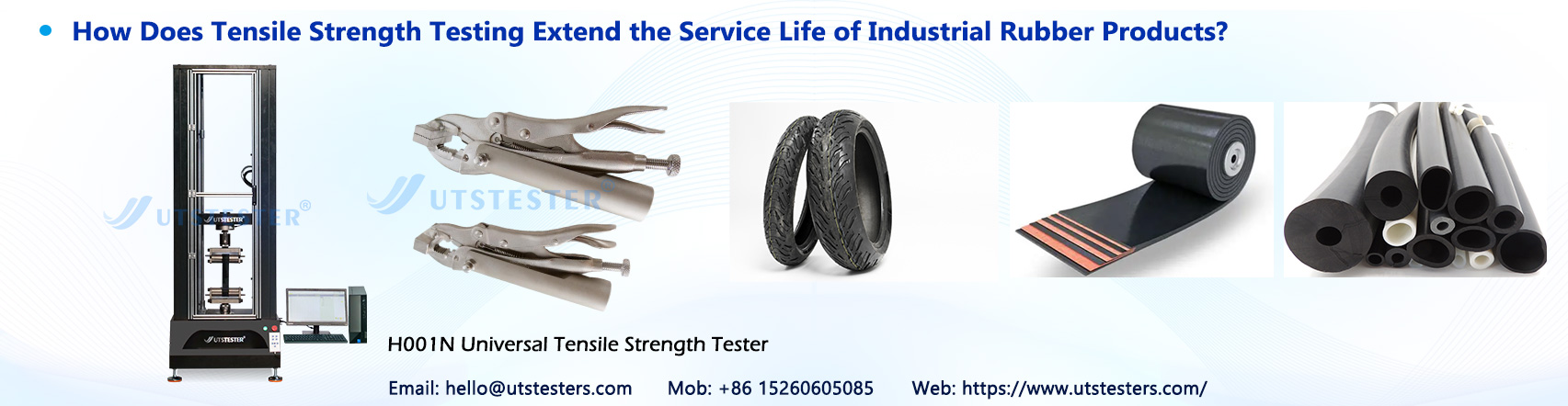
Tensile strength testing is a standardized process that uses specialized testing equipment to simulate the actual stress conditions experienced by rubber products and quantify their tensile performance. It is primarily conducted using a universal testing machine (also known as a tensile testing machine). The entire process strictly adheres to industry standards such as GB/T 528-2009 “Determination of Tensile Stress-Strain Properties of Vulcanized Rubber or Thermoplastic Rubber” and ISO 37 to ensure the accuracy and comparability of the data.
(1) Sample Preparation
1. Sample Cutting: In accordance with standard requirements, rubber materials are cut into test specimens that meet specified dimensions. Common shapes include dumbbell-type specimens (such as Type 1 and Type 2). The width and thickness of the parallel section in the middle of the specimen must be uniform, and the specimen must be free of defects such as bubbles, cracks, or impurities; otherwise, this may lead to deviations in test data.
2. Environmental Conditioning: Rubber properties are significantly affected by temperature and humidity. Testing must be conducted under standard environmental conditions (temperature 23°C ± 2°C, relative humidity 50% ± 5%) to avoid interference from extreme conditions.
3. Instrument Calibration: Calibrate the universal testing machine’s force transducer and tensile speed in advance to ensure measurement accuracy meets requirements (typically force accuracy ≤ ±0.5%).
(2) Testing Procedure
1. Specimen Installation: Secure both ends of the prepared rubber specimen in the upper and lower grips of the testing machine, ensuring the specimen is centered within the grips to prevent uneven stress distribution caused by skewed clamping.
2. Parameter Setup: Set the tensile speed based on the actual application scenario of the rubber product (the standard testing speed for rubber is 500 mm/min, but this can be adjusted for special conditions), then start the testing machine.
3. Data Acquisition: The testing machine uses sensors to record the tensile force and deformation of the specimen in real time throughout the tensile process until the specimen completely breaks. The system automatically generates a force-displacement curve, with key data including tensile strength, elongation at break, and elastic modulus.
(3) Key Indicators
1. Tensile Strength: Directly reflects the tensile limit of the rubber and is the core indicator for determining whether the product meets operational requirements.
2. Elongation at Break: The percentage of the original gauge length that the rubber specimen stretches before breaking, reflecting the rubber’s ductility.
3. Modulus of Elasticity: The ratio of stress to strain during the initial stage of tensile testing, reflecting the rubber’s stiffness.
III. How Does Tensile Strength Testing Accurately Extend the Service Life of Rubber Products?
(1) Design Phase
Product design is the foundation for determining service life, and tensile strength testing provides critical data for rubber material and formulation design.
- Prevent Performance Deficiencies: If tensile strength testing is not conducted during the design phase and low-strength rubber materials are selected without proper evaluation, the product may fail prematurely during actual use.
- Avoiding Over-Engineering: An excessive pursuit of high tensile strength may increase the cost of the rubber formulation, complicate processing, and even compromise other properties such as elasticity and abrasion resistance.
Additionally, tensile strength test data can assist in optimizing product structural design. By testing the tensile strength distribution under different structural designs, structural curvature and thickness can be optimized to reduce localized stress concentration, thereby enhancing the product’s resistance to tensile failure from a structural perspective.
(2) Production Stage
During rubber production, factors such as the vulcanization process, raw material ratios, and processing precision directly influence the formation of the rubber molecular cross-linking network, thereby altering tensile strength. Tensile strength testing serves as a “quality control checkpoint” in the production process, enabling process optimization and performance stability.
- Vulcanization Process Optimization: Vulcanization time, temperature, and pressure are key determinants of rubber cross-linking density. Insufficient vulcanization results in incomplete cross-linking of rubber molecules, leading to low tensile strength; over-vulcanization, with excessively high cross-linking density, causes the rubber to become brittle. Although tensile strength may increase, the elongation at break decreases significantly, making the material prone to brittle fracture. By conducting regular tensile strength tests on production batches, optimal vulcanization parameters can be precisely determined, ensuring consistent tensile performance across every batch.
- Raw Material Formulation Control: The ratio of different rubber raw materials and additives (such as carbon black and vulcanizing agents) significantly affects tensile strength. Through tensile strength testing, raw material formulations can be optimized to find the optimal balance between “strength, processability, and cost,” thereby avoiding product performance fluctuations caused by formulation errors.
(3) Application Stage
- Static Tensile Applications (e.g., pipe sealing gaskets): Focus on tensile strength and long-term deformation performance to prevent rubber fatigue and aging caused by prolonged tension;
- Dynamic Tensile Applications (e.g., automotive hoses, rubber springs for vibrating screens): Balance tensile strength, elongation at break, and fatigue resistance to select rubber materials suitable for dynamic operating conditions through testing.
- Service Life Prediction and Maintenance: By continuously monitoring changes in tensile strength during the service life of rubber products, service life prediction models can be established.
(4) Aging Protection
Industrial rubber exposed to external environments over extended periods may experience issues such as reduced tensile strength and loss of elasticity due to thermal-oxidative aging, ozone aging, and chemical corrosion. Tensile strength testing can be used to evaluate the rubber’s resistance to aging and guide the development of protective measures.
- Screening of Anti-Aging Materials: By comparing the aging rates of tensile strength in rubber after adding different anti-aging additives (such as antioxidants and ozone protectants), long-lasting anti-aging formulations can be identified.
- Optimization of Protection Strategies: For special operating conditions such as high temperatures and high corrosion, tensile strength testing can be used to evaluate the adhesion performance of different protective layers (e.g., anti-corrosion coatings, metal cladding) to the rubber substrate. This ensures that the protective layers do not peel off, providing continuous protection against external erosion and delaying the deterioration of tensile properties.
Email: hello@utstesters.com
Direct: + 86 152 6060 5085
Tel: +86-596-7686689
Web: www.utstesters.com

2/F, 23 Building, Xinronghuayuan, Qingnian road, Xiangcheng Region, Zhangzhou City of Fujian PR, 363000, China.

+86 152 6060 5085

+86 596 7686689


Derechos de autor © UTS International Co., Ltd

 English
 русский
 español
 português
 hello@utstesters.com
 hello@utstesters.com
 +86 152 6060 5085
 +8615260605085