Slip resistance testing protects wearers from falls and protects brands from costly recalls. The equipment measures sole friction on controlled test surfaces, so a lab can prove a shoe grips when it matters.
Buyers face a clear set of decisions. Test method comes first: ramp, portable simulator, or coefficient-of-friction device. Standards support, accuracy, fixtures, automation, data management, and price follow. Each factor shifts with the application and the market a lab serves.
This guide helps buyers match equipment to their application and required standards. It favors no single option. UTS International supports the evaluation as a source of testing expertise.
Key Takeaways
-
Choose the right test method for your lab: ramp testers for reference-grade results, portable simulators for field checks, and COF devices for targeted friction checks.
-
Confirm that your equipment supports the standards you need, such as ASTM F2913 or ISO 13287, to ensure reliable and accepted results.
-
Prioritize accuracy and repeatability, and check that fixtures can handle whole shoes, outsoles, and heel top-pieces in all required sliding modes.
-
Consider automation and data management features that produce audit-ready records and reduce operator error.
-
Weigh long-term value by including purchase price, calibration, consumables, and staff time in your decision.
How Slip Resistance Testing Works
Ramp, Portable, and COF Methods
The basic principle is consistent across equipment types. A shoe is clamped into a device and guided over various test floors while sensors measure the friction between sole and surface.
The ramp tester serves as the current gold standard. The operator places the shoe on an inclined surface and raises the angle until the shoe slips. The device records that critical angle, and the result reflects how steep a slope the footwear can handle before traction fails.
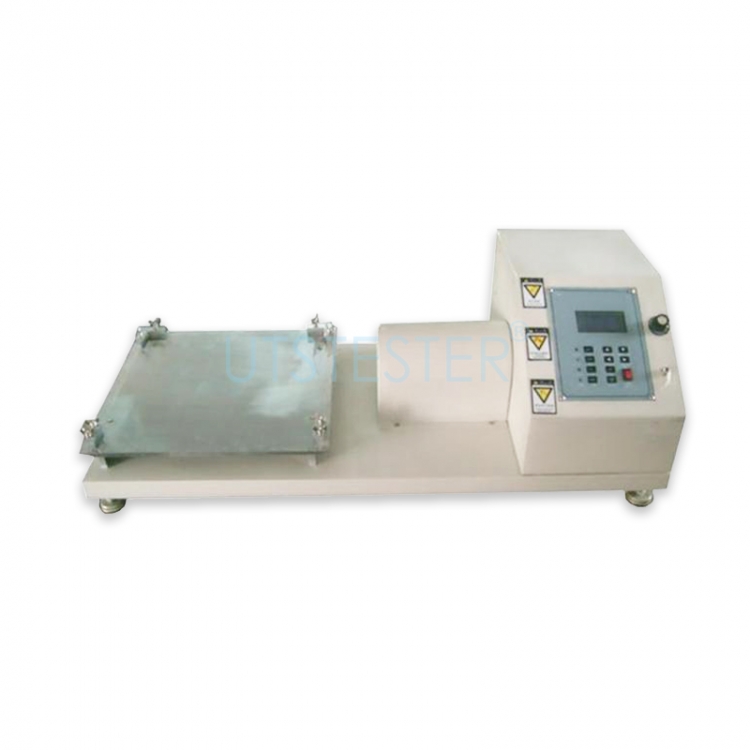
The SST, or Slip Simulator Tester, offers a portable, practical alternative. It suits field checks and facilities that cannot move samples to a fixed lab. COF measurement devices form another option, and a static slip resistance tester measures resistance at the moment movement begins. Each type fits a different setting: the ramp for reference-grade lab work, the SST for mobility, and COF devices for targeted friction checks.
Reading Friction Results
Results appear as dynamic and static coefficients of friction. Static COF describes resistance to starting movement from rest. Dynamic COF is measured while surfaces move against each other.
Interpretation matters more than the raw number. Wikipedia notes that static COF testing has always been unreliable for wet conditions, so a reliable slip resistance test measures dynamic COF for a person who is moving. Safety Direct America explains that pedestrians change contact forces, velocities, and footwear angles while walking, and a stationary sled does not reproduce those conditions. That source also states that no universal rule establishes that a wet static value of 0.60 or 0.50 proves a floor is safe. Static, dynamic, and pendulum measurements are not interchangeable, so each result must be read within its own method.
Slip Resistance Testing Standards
ASTM F2913 and International Methods
ASTM F2913 is the standard test method for measuring the anti-slip performance of finished footwear. It applies to whole shoes, outsoles, heel top-pieces, and sole materials. Test media include water, ice, and grease, and the standard flooring is steel plate and Tile 3. The method records the instantaneous friction force at 0.1 s after sliding starts, at a sliding speed of 0.3 m/s. Normal force is 500 N for shoe sizes of 250 mm and above, and 400 N below that size. Three test modes exist: heel sliding forward, forepart sliding backward, and flat sliding forward, with a 7.0° angle in the first two modes.
|
Parameter
|
Requirement
|
|
Surfaces
|
Smooth ceramic tile and polished steel
|
|
Conditions
|
Wet with detergent and coated with oil
|
|
Measurement
|
Dynamic coefficient of friction (DCOF)
|
|
Target
|
DCOF of 0.40 or higher on wet surfaces
|
Rating follows ASTM F3445-24. An SR mark requires a COF of 0.40 or higher on dry and wet surfaces. An SRO mark adds 0.33 or higher on an oily/wet surface. ASTM notes that F2913 derives from SATRA TM144, a widely used standard from SATRA Technology Center in England. Other markets apply their own methods, so a lab may need an ISO 13287 slip resistance tester alongside an ASTM rig.
Calibration and Certification Support
Buyers should confirm that equipment supports the exact standards their lab must follow. Calibration support matters just as much. Suppliers commonly offer instrument calibration, certification programs, and calibration tiles for verifying reference surfaces. Field verification is also possible on some portable devices, where an operator hangs the load assembly vertically and compares the pointer to calibration markings. Annual factory service keeps precision instruments at peak performance.
Accreditation signals that a lab holds the technical competence and quality control to produce reliable results. UKAS describes accreditation to ISO/IEC 17025:2017 as proof of appropriate equipment and sound procedures. UTS International helps buyers confirm standards alignment before purchase, which reduces the risk of a costly mismatch between instrument and method.
Core Factors in Slip Resistance Testing Equipment
Accuracy, Fixtures, and Automation
Accuracy and repeatability rank as the top selection criterion. A tester that produces a different number on every run cannot support a pass/fail decision or a certification claim. Safety Direct America describes its resistance tester as a source of reliable, repeatable data for evaluating pedestrian and road surfaces. Walkway Management Group reports that pendulum testing is recognized globally and delivers reliable, repeatable results for walkway slip resistance and compliance work. The BOT-3000E tribometer goes further, with greater precision on complex surfaces and consistently more accurate, repeatable results.
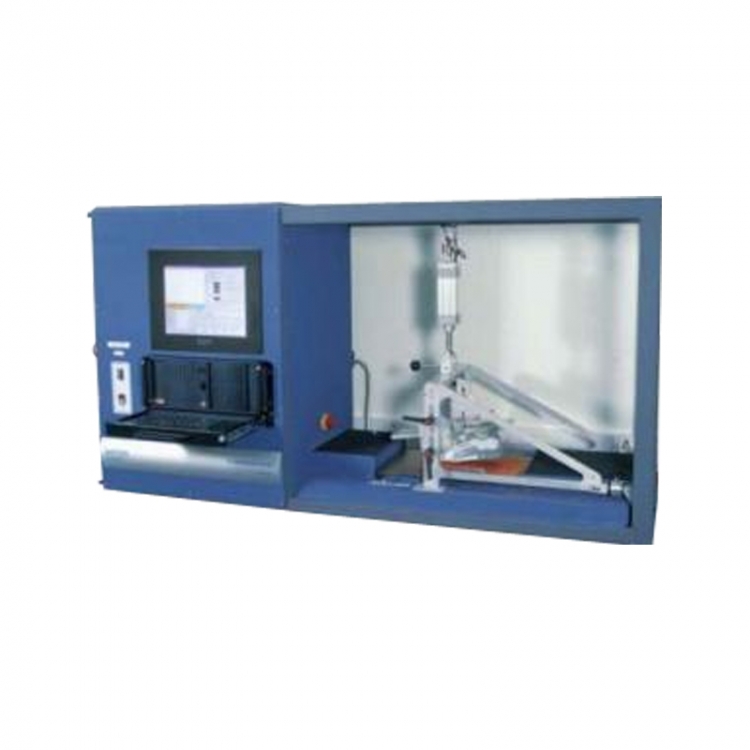
Fixture design decides how well a machine handles real footwear. The clamp must hold a whole shoe, an outsole, or a heel top-piece in the correct test position, and it must reproduce the heel-forward, forepart-backward, and flat sliding modes that ASTM F2913 defines. A dedicated shoe heel slip resistance tester gives labs a fixture built around heel geometry, which simplifies setup for heel-specific evaluations. Automation adds value here. Motorized positioning removes operator judgment from the clamp angle and table position, so two technicians can run the same sample and expect the same result.
Modern machines show how far this has progressed. SafetyBiz lists automated table positioning, computer interfaces, and pinch-point guards on the current James Machine. The Michelman-James machine adds a digital COF display, calibration-free humidity and temperature gauges, and a printer interface. The KETT/Heidon 94i machine uses a solenoid to apply force to the slider, and its internal computer integrates horizontal and vertical transducer signals into a digital readout, with an average button for collecting multiple readings.
Data Management and Smart Testers
Recordkeeping has become part of the equipment decision. Walkway Management Group notes that companies now store digital results with time stamps, test conditions, and friction scores, and treat those logs as evidence in claims or injury reports. The same source describes how teams feed slip test data into safety software to spot trends, schedule maintenance, and assign corrective actions.
Computer-controlled smart testers make that workflow practical. Walkway Management Group reports that smart tribometers such as the BOT-3000E provide real-time data, automatic reporting, and consistent results regardless of the operator, which reduces human error. Digital devices capture multiple readings quickly, generate automated reports, and improve accuracy through precise calibration. Dynatest describes highway friction systems that let operators enter customized test patterns and annotate conditions, then store friction values alongside speed, temperature, and water flow rate for printing during or after the test. Preset parameters and automatic recording turn slip resistance testing into a documented, repeatable process rather than a hand-written log.
Price, Value, and Mistakes to Avoid
Cost Drivers and Long-Term Value
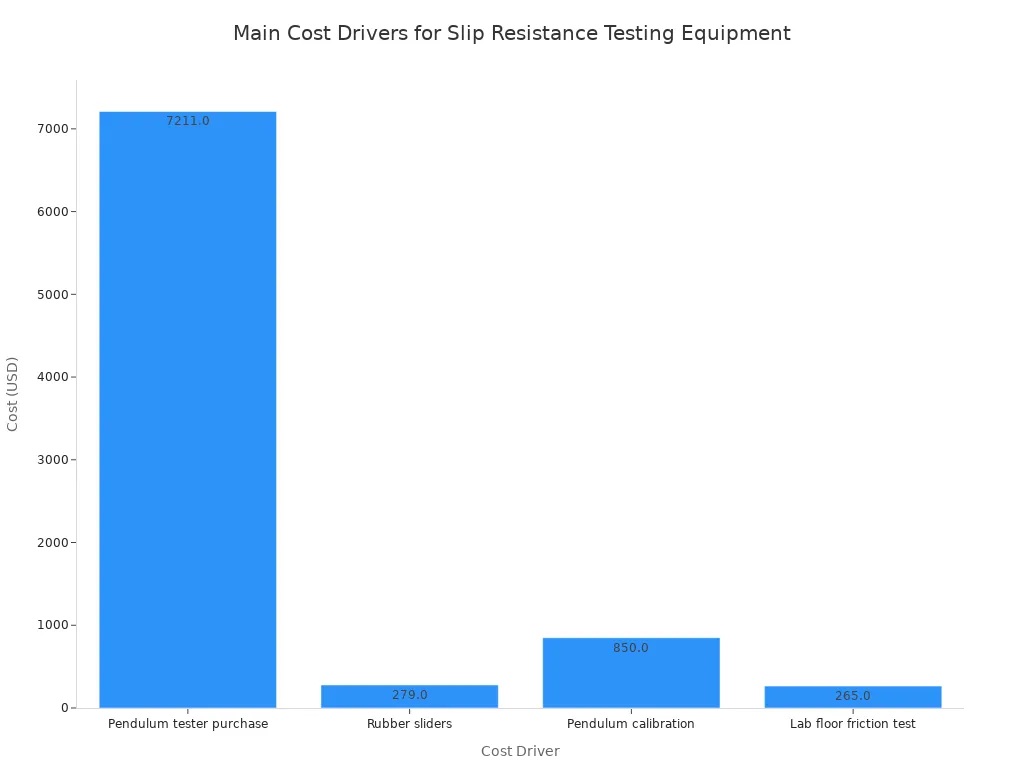
Three factors drive the purchase price: test method type, automation level, and data features. A pendulum tester sits at the lower end of the market. Safety Direct America lists a pendulum tester at $7,211.00 delivered to the lower 48 states, or $7,732.00 with a verification holder and float glass. A British Pendulum PTV Slip Tester from SlipDoctors runs $8,800.00, and a rental costs $800.00. Consumables and service add to the total. Safety Direct America prices rubber sliders at $279.00 for the rubber alone, pendulum calibration at $850.00 plus shipping, and a lab floor friction test at $265.00 per sample.
Safety Direct America illustrates how these line items stack up across a testing program.
Upfront price tells only part of the story. A computer-controlled smart tester costs more at purchase, yet it reduces operator error and produces audit-ready records. Uncalibrated equipment offers zero protection in a courtroom, according to a LinkedIn analysis of skid resistance methods. Buyers should weigh the full cost of ownership: purchase, calibration, consumables, and staff time.
Common Buyer Mistakes
The most expensive mistake is buying without confirming standards support. An ASTM standard written for one tribometer does not apply to another, and no method yet correlates results across tribometer classes, per the Floor Covering Reference Manual. Results from different devices are not interchangeable. Buyers should also plan for calibration and operator certification, which the same source calls mandatory.
A second trap is relying on withdrawn or irrelevant methods. Safety Direct America notes that ASTM F1679 and ASTM F1677 were withdrawn in 2006, and that dry static COF tests do not predict real-world slip resistance. A third error is overlooking fixture compatibility, such as whether the clamp handles whole shoes, outsoles, and heel top-pieces in every required sliding mode. Each equipment type fits a distinct role, so buyers should match the device to their slip resistance testing scope rather than chase a single ranking.
A sound purchase decision rests on five checks:
-
Test method fit: ramp, portable simulator, or COF device, matched to the lab's setting.
-
Standards support, including ASTM F2913 and any market-specific method.
-
Accuracy and fixture compatibility across whole shoes, outsoles, and heel top-pieces.
-
Automation and data management that produce audit-ready records.
-
Long-term value across purchase, calibration, consumables, and staff time.
Buyers should define their testing scope and required standards first. They can then compare each machine against those requirements rather than against a rival model. UTS International supports that evaluation and the setup that follows, which keeps slip resistance testing aligned with the methods a lab must follow.
FAQ
Which test method suits a small lab with limited space?
A portable simulator fits tight spaces and field checks. A ramp tester delivers reference-grade results but needs a fixed footprint. A lab that serves multiple markets may pair an ISO 13287 slip resistance tester with an ASTM rig. The testing scope should drive the choice.
Can one device cover both static and dynamic friction?
Not usually. Static and dynamic measurements use different procedures and are not interchangeable. A lab that needs both should plan for separate instruments. A static slip resistance tester covers the moment movement begins, while dynamic methods capture friction during motion.
How does a lab verify heel-specific performance?
Heel geometry needs a fixture built around it. A shoe heel slip resistance tester holds the heel top-piece in the correct position and reproduces the heel-forward sliding mode. Buyers should confirm the clamp handles whole shoes, outsoles, and heel top-pieces before purchase.
What records should a slip test program keep?
Digital logs should capture time stamps, test conditions, and friction scores. These records support claims and injury reports. Computer-controlled testers generate automatic reports and reduce operator error, which makes the data easier to defend.
Does a higher price guarantee better results?
No. Price reflects method type, automation, and data features. A low-cost pendulum can serve compliance work well. A smart tester costs more upfront but cuts operator error and produces audit-ready records. Buyers should weigh calibration, consumables, and staff time alongside the purchase price.


 +86 152 6060 5085

 English
 русский
 español
 português
 العربية
 Polski




 hello@utstesters.com
 hello@utstesters.com
 +86 152 6060 5085
 +8615260605085
