A lo largo de toda la cadena de producción y comercialización textil, el color es uno de los elementos más intuitivos que perciben los consumidores. Sin embargo, cuando una prenda nueva de color brillante se decolora o destiñe tras unos pocos lavados, no solo afecta a la experiencia de uso, sino que también puede suponer un riesgo para la salud del consumidor. Mediante la simulación científica de las condiciones de lavado, el probador de solidez del color proporciona una base precisa y cuantificable para evaluar la durabilidad del color de los textiles.
I. ¿Qué es la solidez al lavado? ¿Por qué es tan importante?
La solidez del color se refiere a la capacidad de los textiles teñidos o estampados para resistir diversos factores externos (como el lavado, la fricción, la transpiración y la exposición a la luz) durante su procesamiento o uso. Entre estos, la solidez al lavado mide específicamente la capacidad de un textil para mantener la estabilidad del color durante el proceso de lavado, abarcando dos aspectos:
- Cambio de color: El grado de cambio de color en la propia muestra después del lavado.
- Manchas: Grado en que el color de la muestra migra a tejidos adyacentes (como entretelas multifibra).
La solidez del color influye directamente en la durabilidad, el atractivo estético y la experiencia del usuario. Los productos que no superan las pruebas de solidez del color pueden presentar problemas como decoloración o manchas durante su uso o lavado. Estos problemas no solo comprometen la apariencia, sino que también pueden liberar moléculas de tinte dañinas o iones de metales pesados, que pueden ser absorbidos por la piel y representar una amenaza potencial para la salud.
II. Principio de funcionamiento del probador de solidez del color al lavado
El principio de funcionamiento fundamental del probador de solidez del color al lavado consiste en simular procesos de lavado domésticos o comerciales estandarizados. Durante la prueba, la muestra textil se adhiere a un tejido de soporte estándar, se sumerge en una solución de lavado estándar y se somete a agitación mecánica durante un tiempo determinado a una temperatura específica. Tras el enjuague y el secado, se evalúa el grado de cambio y transferencia de color mediante una escala de grises.
Parámetros clave:
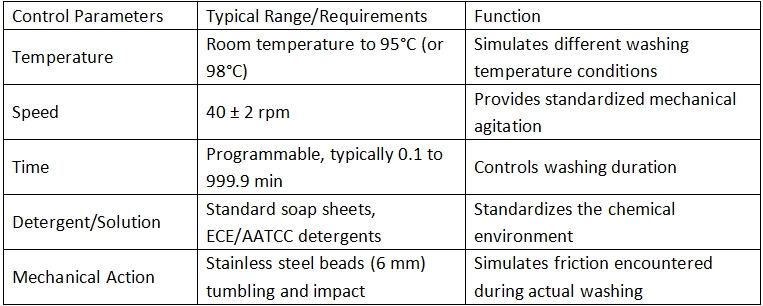
Los modernos instrumentos de prueba de alta gama suelen estar equipados con sistemas de control programables, módulos de control de temperatura PID de alta precisión, sistemas de calentamiento por relé de estado sólido y recipientes de prueba intercambiables (opciones de 500 ml o 1200 ml), lo que garantiza que las fluctuaciones de temperatura se mantengan dentro de ±1 °C y elimina eficazmente el "sobreimpulso" de temperatura.
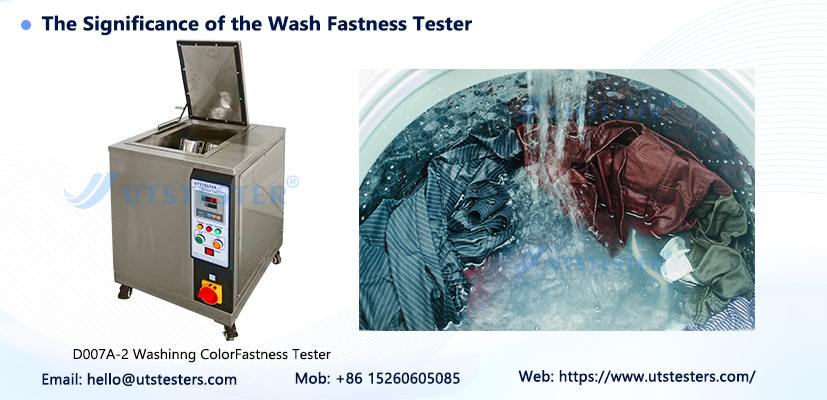
III. La importancia de los probadores de solidez al lavado
1. Garantizar la seguridad y la salud del consumidor.
Los textiles que no superan las pruebas de solidez del color pueden liberar moléculas de tinte al exponerse a la lluvia, el sudor o el lavado, las cuales pueden ser absorbidas por la piel e incluso contener sustancias nocivas como iones de metales pesados. Mediante pruebas estandarizadas,
probadores de solidez al lavado
Garantizar que los productos cumplan con los requisitos de seguridad nacionales e internacionales, incluidas las normas GB de China, el Reglamento REACH de la UE y la certificación OEKO-TEX®, salvaguardando así la salud del consumidor desde el origen.
2. Mejorar la competitividad del producto
En el mercado textil, altamente competitivo, una alta solidez del color significa mayor durabilidad y fiabilidad. Mediante rigurosas pruebas de resistencia al lavado, las empresas pueden:
- Seleccionar tintes y auxiliares de alta calidad para optimizar los procesos de teñido.
- Reducir las quejas y devoluciones de los clientes causadas por la decoloración o el sangrado de color.
- Construir una reputación de marca basada en la calidad y ganarse la confianza del consumidor a largo plazo.
3. Cumplimiento de las regulaciones internacionales y los requisitos de acceso al comercio.
Los distintos países y regiones tienen requisitos reglamentarios estrictos en cuanto a la solidez del color de los textiles:
- China: GB/T 3921 “Textiles—Ensayos de solidez del color—Solidez del color al lavado con jabón”
- Internacional: Serie ISO 105-C06
- Norteamérica: AATCC 61 (Resistencia al lavado con jabón), AATCC 190
- Japón: JIS L0844
- Reino Unido/UE: BS EN ISO 105-C06
4. Optimizar los procesos de producción y el control de costes.
Durante la fase de desarrollo del producto, se utilizan pruebas de solidez del color para evaluar la estabilidad de los tintes y los procesos. Utilizando los datos de las pruebas, los técnicos pueden:
- Evaluar la eficacia de los fijadores y optimizar los procesos de acabado.
- Identificar problemas relacionados con la adhesión insuficiente entre el tinte y la fibra.
- Evitar pérdidas financieras significativas derivadas del descubrimiento de incumplimientos en materia de solidez del color solo después de la producción en masa.
5. Cobertura de una amplia gama de categorías textiles.
El ámbito de aplicación de las pruebas de solidez del color en los probadores de lavado es extremadamente amplio y adecuado para:
- Fibras naturales: algodón, lino, lana, seda, etc.
- Fibras sintéticas: poliéster, nailon, acrílico, elastano, etc.
- Tejidos mezclados y entretejidos: diversos tejidos mezclados
- Categorías de productos terminados: tejidos para prendas de vestir (camisas, mezclilla, ropa deportiva), textiles para el hogar (sábanas, cortinas, toallas), textiles industriales
- Otros materiales: cuero, plásticos, etc.
IV.
Probadores modernos de solidez al lavado
Con el continuo avance de la tecnología de ensayo textil, los modernos probadores de solidez al lavado han mostrado las siguientes tendencias:
Inteligencia y automatización
- Pantalla táctil a color de 7 pulgadas: Cuenta con interfaces integradas en chino e inglés, compatible con la selección de estándares de prueba con un solo clic, personalización de parámetros, calibración de temperatura y exportación de datos.
- Programación de macros: Permite grabar y guardar procedimientos de prueba comunes para automatizar las pruebas por lotes.
- Algoritmo de control inteligente de temperatura: Las fluctuaciones de temperatura se mantienen dentro de ±1 °C, lo que garantiza la precisión de las pruebas.
Diseño modular y de modo dual
- Control independiente de doble tanque: Permite analizar simultáneamente dos conjuntos de muestras a diferentes temperaturas o en diferentes condiciones, lo que mejora significativamente la eficiencia de las pruebas.
- Compatibilidad con modos de limpieza en húmedo y en seco: Al cambiar los detergentes y ajustar los parámetros del proceso, el instrumento cubre estándares de limpieza en seco como ISO 105-D01 y AATCC 132.
- Sistema modular de soporte para vasos: Los vasos de prueba intercambiables de 500 ml/1200 ml se adaptan a diversos tamaños de muestra y requisitos estándar.
Seguridad, protección y durabilidad
- Múltiples protecciones de seguridad: alarma de bajo nivel de agua, alarma de sobretemperatura, alarma de puerta abierta y protección contra funcionamiento en seco.
- Construcción en acero inoxidable 304/316: Altamente resistente a la corrosión, apto para uso prolongado y de alta frecuencia.
- Control mediante relé de estado sólido: Sin contactos mecánicos, temperatura estable, funcionamiento silencioso y larga vida útil.
Gestión y trazabilidad de datos
- Registro del historial de pruebas: Almacena curvas de temperatura, parámetros de prueba y resultados para una fácil trazabilidad de la calidad.
- Función de exportación de datos: Admite la exportación a través de USB o interfaz de red para una generación conveniente de informes de prueba.
Correo electrónico:
hello@utstesters.com
Directo: +86 152 6060 5085
Teléfono: +86-596-7686689
Web:
www.utstesters.com


 +86 152 6060 5085
 English
 русский
 español
 português
 العربية
 Polski


 hello@utstesters.com
 hello@utstesters.com
 +86 152 6060 5085
 +8615260605085